Symmetry-induced Disentanglement on Graphs
The 36th Conference on Neural Information Processing Systems (NeurIPS 2022)
Giangiacomo Mercatali, André Freitas, Vikas Garg
TLDR We propose a new formalization for disentanglement on graphs using tools from Lie Algebras. We then provide a mechanism to encode graph properties into subgroups within a Variational Autoencoder framework.
Introduction to disentanglement
- Disentangled representations [1,2] encode information about the salient (or explanatory) factors of variation in the data, and isolate each specific factor in only a few dimensions, unraveling the underlying interactions of complex data.
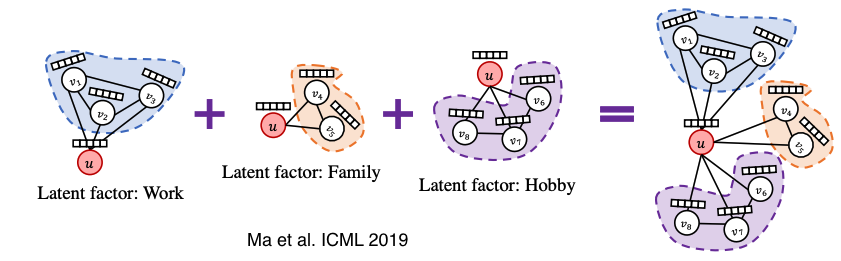
- Graph disentanglement [3,4] aims to factorize the semantic factors using graph convolutional networks, e.g. distinguishing the neighborhood type (work, family, hobby) in a social network.
Formalization of disentanglement
In this work we provide a notion of symmetry-induced disentanglement for graphs, following the formalization from Higgins et al. 2018 [5], leveraging tools from Lie algebras.
Lie group and Lie Algebra
A Lie group \(G\) is a group of symmetries where the symmetries are continuous. A Lie group is associated with a Lie algebra \(\mathfrak{g}\), which is the tangent space to the identity element of \(G\). A Lie algebra is parameterized with a basis \(\{\mathbb{A}_i\}_{i=1}^k\), where every element in \(\mathfrak{g}\) can be written as \(\mathbb{A} = \mathbb{A}_1 t_1 + \ldots + \mathbb{A}_k t_k\), where \(t_i\) are the coordinates. The elements of the Lie algebra can be mapped into the Lie group with an exponential function: \(\exp: \mathfrak{g} \rightarrow G\).
Intuition
The latent representation \(\hat{Z}\) is disentangled with respect to the Lie group \(G\), if a change in the coordinate \(t_i\) is associated with a change in \(\hat{z}_i\).
Unconditional disentanglement
The graph embedding \(\hat{Z}\) obtained by \(\textstyle f(\hat{Z}|T)\) is unconditionally disentangled with respect to the Lie group coordinates \(\textstyle T=\{t_j\}_{j=1}^k\) if: (1) there is a group action on \(\textstyle \hat{Z}\): \(\cdot : G \times \hat{Z} \rightarrow \hat{Z}\), (2) the map \(\textstyle f = \exp \mathbb{A}(T): T \rightarrow \hat{Z}\) is equivariant between actions on \(T\) and \(\hat{Z}\), (3) there is a decomposition \(\textstyle \hat{Z} = \hat{z}_1 \times \hat{z}_2 \ldots \times \hat{z}_k\), where each coordinate \(t_i\) affects only the corresponding component \(\hat{z}_i\).
Conditional disentanglement
The graph embedding \(\textstyle \hat{Z}\) obtained by \(\textstyle f(\hat{Z}|T, Z)\) is conditionally disentangled with respect to the Lie group coordinates \(\textstyle T=\{t_j\}_{j=1}^k\) conditioned on \(Z\) if (1) there is a group action on \(\textstyle \hat{Z}\): \(\cdot : G \times \hat{Z} \rightarrow \hat{Z}\), (2) the map \(\textstyle f:\exp \mathbb{A} (T) \times Z \rightarrow \hat{Z}\) is equivariant between actions on \(T\) and \(\textstyle \hat{Z}\) for any fixed \(Z\), and (3) \(\textstyle \exp \mathbb{A} (T)\) factorizes into the product \(\textstyle \prod_{i=1}^k \exp (t_i \mathbb{A}_i) \times Z\) such that each component \(\textstyle \exp (t_i \mathbb{A}_i) \times Z\) is affected only by the corresponding coordinate \(\textstyle t_i\) for \(i \in \{1, 2, \ldots, k\}\).
Proposed Lie group VAE model
- We design a generative model based on the Variational Autoencoder framework.
- We provide conditional or unconditional versions of the ELBO.
- The ELBO is implemented with 4 modules: 2 encoders, 2 decoders.
Probabilistic model
We consider the graph data \(\mathcal{G}=(X,\mathcal{A})\) and two latent variables \(Z\) (graph encoding) and \(T\) (group encoding).
Unconditional ELBO
\(\mathcal{L_{\text{unc}}} = \mathbb{E}_{q(Z|\mathcal{G}) q(T|Z)} \log p(\mathcal{G}|\hat{Z}) p(\hat{Z}|T) - \mathbb{E}_{q(Z|\mathcal{G})} \text{KL} (q(T|Z) || p(T)) - \mathbb{E}_{q(Z|\mathcal{G})} \log q(Z|\mathcal{G})\)
Conditional ELBO
\(\mathcal{L_{\text{cond}}} = \mathbb{E}_{q(Z|\mathcal{G}) q(T|Z)} \log p(\mathcal{G}|\hat{Z}, Z) p(\hat{Z}|T) - \mathbb{E}_{q(Z|\mathcal{G})} \text{KL} (q(T|Z) || p(T)) - \mathbb{E}_{q(Z|\mathcal{G})} \log q(Z|\mathcal{G})\)
Architecture
We provide a graph VAE with an additional Lie group autoencoder.
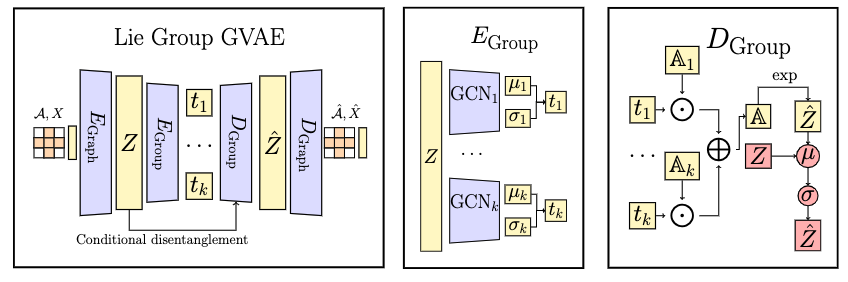
Graph encoder (\(E_{\text{graph}}\))
VAE reparameterization that maps to latent variable \(Z\)
\(q(Z | X, \mathcal{A}) = \mathcal{N}(Z | \mu, \text{diag}(\sigma^2))\) where \(\mu = \text{GCN}_{\mu}(\overline{X}, \mathcal{A})\), \(\log \sigma = \text{GCN}_{\sigma}(\overline{X}, \mathcal{A})\) and \(\overline{X}=\text{Pool}(\text{GCN}(X, \mathcal{A}))\)
Group encoder (\(E_{\text{group}}\))
VAE reparameterization that maps to coordinates \(\{T_i\}_{i=1}^k\):
\(q(T|Z, \mathcal{A}) = \prod\nolimits_{i=1}^k q(t_i | Z, \mathcal{A})\) with \(q(t_i | Z, \mathcal{A}) = \mathcal{N}(t_i | \mu_i, \text{diag}(\sigma_i^2))\)
Group decoder (\(D_{\text{group}}\))
For each coordinate \(t_i \in T\), we learn a Lie algebra basis element \(\{\mathbb{A}_i\}_{i=1}^k \in \mathfrak{g}\). The coordinates and basis are then aggregated and fed into an exponential mapping layer, to achieve a group representation.
\(p(\hat{Z} | T) = g(T) = \exp \mathbb{A}(T)\) where \(\mathbb{A}(T) = \sum\nolimits_{i=1}^k t_i \mathbb{A}_i \quad \text{for} \ g \in G, \ \mathbb{A} \in \mathfrak{g}\)
The conditional case involves conditioning on \(Z\):
\(\mathbb{A}(T) = p(\hat{Z} | Z, T) = \sigma(\text{agg}[\exp \mathbb{A}(T), Z])\), where \(Z = \{z_j\}_{j=1}^k\)
Graph decoder (\(D_{\text{graph}}\))
We map the latent \(\hat{Z}\) into \(N\) latent variables using sigmoid functions \(\sigma_j\), and then aggregates the \(N\) latent variables to obtain the full graph representation.
\(p(\mathbb{A}, X | \hat{Z}) = \prod\nolimits_{j=1}^N \big[ p(\mathbb{A}, X| \sigma_j (\hat{Z}) ) \big]\)
Discussion
Limitations
- Currently quantitative evaluation is limited to synthetic graphs (same as in images)
- Further discussions on identifiability and causality of disentanglement can be explored.
Conclusion
- We formalize the notion of conditional disentanglement on graphs and propose a novel framework for graph disentanglement by leveraging tools from Lie algebras.
- We design a graph VAE based on a Lie group parameterization, and provide a novel ELBO criteria for optimizing conditional disentanglement.
- Experiments on quantitative disentanglement, few-shots classification and molecular generation provide evidence of the capabilities of our model.
References
- Van Steenkiste et al. Are disentangled representations helpful for abstract visual reasoning? NeurIPS 2019
- Bengio et al . Representation learning: A review and new perspectives. TPAMI 2013
- Ma et al, Disentangled graph convolutional networks, ICML 2019
- Yang et al. Factorizable graph convolutional networks NeurIPS 2020
- Higgins et al. Towards a definition of disentangled representations. Arxiv 2018